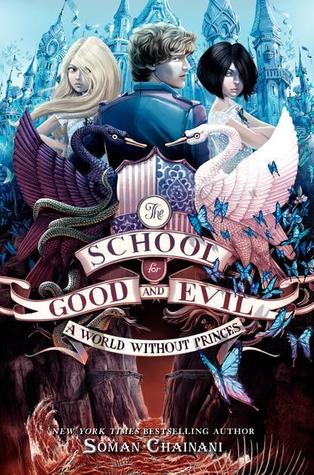
"In the epic sequel to the New York Times bestselling novel, The School for Good and Evil, Sophie and Agatha are home, living out their Ever After. But life isn’t quite the fairy tale they expected.
When Agatha secretly wishes she’d chosen a different happy ending, she reopens the gates to the School for Good and Evil. But the world she and Sophie once knew has changed.
Witches and princesses, warlocks and princes are no longer enemies. New bonds are forming; old bonds are being shattered. But underneath this uneasy arrangement, a war is brewing and a dangerous enemy rises. As Agatha and Sophie battle to restore peace, an unexpected threat could destroy everything, and everyone, they love—and this time, it comes from within."
Wow. Seriously, this was better than the first one. This went into topics that I've never seen handled in this setting, and it was brilliant. Just like how the first book poked fun at the idiotic fairy-tale "good/evil" tropes--animal conversation class for the Evers, uglification for the Nevers--the second one went even further, exploring the balance between the genders and all possible imbalances that have or could occur. It was fantastic, honestly. I felt like the plot was intricate and there weren't really any blah, flat plot devices. Everything fit in, everything made sense, and the plot twists were unexpected but fit perfectly in with everything. I loved the way the characters were handled, too: there were insane levels of complexity without really making me feel like anything was out-of-character. Each one was put through different circumstances and had to deal with them, some characters were pitted against one another by manipulation but still had their own struggles, and all of them were allowed to show more of their character than the first book. The ending made me start desperately needing to read the third one, which is a shame since it's not out yet. I think this series is highly enjoyable and well worth the read. I recommend it really highly. 4.5 to 5 stars. There's not a copy at the libraries yet, but you should try and find it if you can.

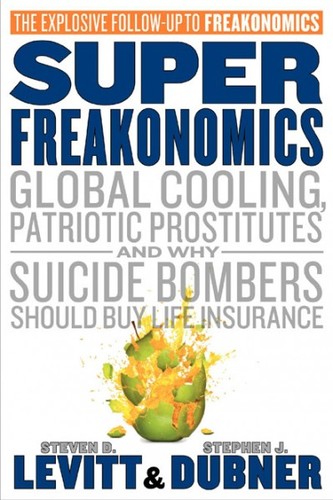
"Four years in the making, SuperFreakonomics asks not only the tough questions, but the unexpected ones: What's more dangerous, driving drunk or walking drunk? Why is chemotherapy prescribed so often if it's so ineffective? Can a sex change boost your salary?
SuperFreakonomics challenges the way we think all over again, exploring the hidden side of everything with such questions as:
How is a street prostitute like a department-store Santa?
Why are doctors so bad at washing their hands?
How much good do car seats do?
What's the best way to catch a terrorist?
Did TV cause a rise in crime?
What do hurricanes, heart attacks, and highway deaths have in common?
Are people hard-wired for altruism or selfishness?
Can eating kangaroo save the planet?
Which adds more value: a pimp or a Realtor?
Levitt and Dubner mix smart thinking and great storytelling like no one else, whether investigating a solution to global warming or explaining why the price of oral sex has fallen so drastically. By examining how people respond to incentives, they show the world for what it really is – good, bad, ugly, and, in the final analysis, super freaky.
Freakonomics has been imitated many times over – but only now, with SuperFreakonomics, has it met its match."
I couldn't resist reading the sequel to Freakonomics, and this doesn't need you to read the first one because both are a completely jumbled analysis of random things. I don't feel like this one was quite as good as the first one--a little more random, a little less organized, a tiny bit more out there. I feel like it could have benefitted even from more broken-down chapters or headers; as is, the random interjections were just a bit hard to keep track of. And don't get me wrong, there was still a lot of really interesting stuff in there, but there were also a couple parts that had me skeptical. I get that most of their job is essentially turning conventional knowledge on its head, but a few cases--notably the global warming and chemo chapters--had me really wanting to get some second opinions and extra sources. For the most part, though, the subjects were as entertaining and thought-provoking as ever. I'd probably recommend reading it, and even if you don't want to read the whole thing, read the epilogue. It's one of the truly greatest things about the book. I'm serious: cappuccian capitalism. It's worth it, dude. Anyway, the book's at Kettleson but you'll have to pick it up in a month when they reopen. Ah well. Absence makes the heart grow fonder, and all that. Ciao!

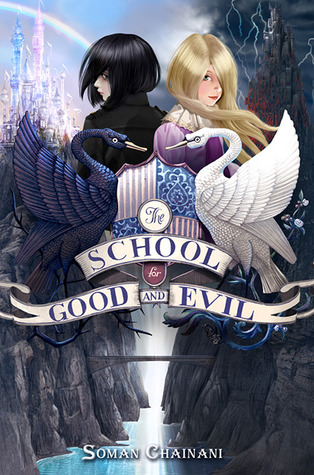
'The first kidnappings happened two hundred years before. Some years it was two boys taken, some years two girls, sometimes one of each. But if at first the choices seemed random, soon the pattern became clear. One was always beautiful and good, the child every parent wanted as their own. The other was homely and odd, an outcast from birth. An opposing pair, plucked from youth and spirited away.
This year, best friends Sophie and Agatha are about to discover where all the lost children go: the fabled School for Good & Evil, where ordinary boys and girls are trained to be fairy tale heroes and villains. As the most beautiful girl in Gavaldon, Sophie has dreamed of being kidnapped into an enchanted world her whole life. With her pink dresses, glass slippers, and devotion to good deeds, she knows she’ll earn top marks at the School for Good and graduate a storybook princess. Meanwhile Agatha, with her shapeless black frocks, wicked pet cat, and dislike of nearly everyone, seems a natural fit for the School for Evil.
But when the two girls are swept into the Endless Woods, they find their fortunes reversed—Sophie’s dumped in the School for Evil to take Uglification, Death Curses, and Henchmen Training, while Agatha finds herself in the School For Good, thrust amongst handsome princes and fair maidens for classes in Princess Etiquette and Animal Communication.. But what if the mistake is actually the first clue to discovering who Sophie and Agatha really are…?
The School for Good & Evil is an epic journey into a dazzling new world, where the only way out of a fairy tale is to live through one."
I've been wanting to read this book forever, ever since I saw the advance copy and somebody else got to it first. They finally lent it to me, so I promptly finished all five hundred pages in about two days. I think my opinion of each character changed quite a bit over the course of the book, because there was a lot of character development and change. A few of the more major and general points were pretty easily anticipated, but there was a lot going on in the plot that was unexpected or interesting. Though talking about the character evolution, at times I didn't really feel like investing or believing quite so heavily in the redemption path that some took. In other words, there were a couple characters that acted so rampantly... uhhh... self-centered or nasty or shallow (to use the polite phrases) that by the end when they'd stepped into their "new light," I still had a little dislike and skepticism nagging at the back of my mind. But that was just a few cases. For the most part I loved the changes and twists that essentially all the characters went through, working with the central questioning of the black-and-white categories of Good and Evil. And what had hooked me in was the premise, something really interesting that I don't think I've ever seen before. It was a really cool story to read, and I think overall it was done justice. The plot got really surprisingly complicated, in ways I didn't expect. It was a nice surprise to see more layers to it. I definitely enjoyed it a lot, and I know a lot of others have too. I'd very much recommend this if you're into fairy tales, or even any kind of fantasy. Four and a half stars. There's a copy at Blatchley.

"Which is more dangerous, a gun or a swimming pool? What do schoolteachers and sumo wrestlers have in common? Why do drug dealers still live with their moms? How much do parents really matter? How did the legalization of abortion affect the rate of violent crime?
These may not sound like typical questions for an economist to ask. But Steven D. Levitt is not a typical economist. He is a much-heralded scholar who studies the riddles of everyday life—from cheating and crime to sports and child-rearing—and whose conclusions turn conventional wisdom on its head.
Freakonomics is a groundbreaking collaboration between Levitt and Stephen J. Dubner, an award-winning author and journalist. They usually begin with a mountain of data and a simple question. Some of these questions concern life-and-death issues; others have an admittedly freakish quality. Thus the new field of study contained in this book: freakonomics.
Through forceful storytelling and wry insight, Levitt and Dubner show that economics is, at root, the study of incentives—how people get what they want, or need, especially when other people want or need the same thing. In Freakonomics, they explore the hidden side of . . . well, everything. The inner workings of a crack gang. The truth about real-estate agents. The myths of campaign finance. The telltale marks of a cheating schoolteacher. The secrets of the Klu Klux Klan.
What unites all these stories is a belief that the modern world, despite a great deal of complexity and downright deceit, is not impenetrable, is not unknowable, and—if the right questions are asked—is even more intriguing than we think. All it takes is a new way of looking.
Freakonomics establishes this unconventional premise: If morality represents how we would like the world to work, then economics represents how it actually does work. It is true that readers of this book will be armed with enough riddles and stories to last a thousand cocktail parties. But Freakonomics can provide more than that. It will literally redefine the way we view the modern world."
So, it may look a little daunting and non-fiction-y, but this one's honestly pretty short (like 200 pages) and very quick to get through. The topics are, as professed, a bit random, but all of the information was hugely interesting to hear about. I really liked in particular the analysis of factors determining success/change in children, versus the surprisingly ineffective factors. It gave me a lot of new information and opened up a lot of questions in my mind, which is exactly what I think the authors were going for. I got a lot out of reading it, and in my opinion it was really, really good. It was on the same level as the Bill Bryson book I reviewed last week or so. I think it's extremely worth reading. I'm gonna end it there because I caught the SFAC sickness and feel not-so-great at the moment, but rest assured that I give this 4.5 stars. There are copies at Kettleson, Sitka High, and MEHS.

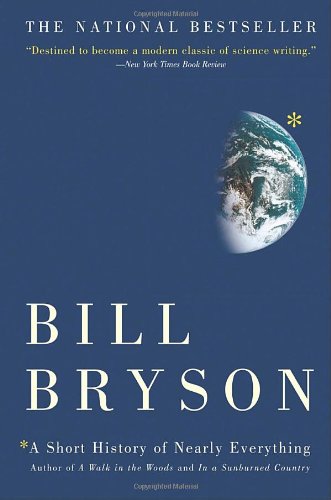
"Bill Bryson is one of the world’s most beloved and bestselling writers. In A Short History of Nearly Everything, he takes his ultimate journey–into the most intriguing and consequential questions that science seeks to answer. It’s a dazzling quest, the intellectual odyssey of a lifetime, as this insatiably curious writer attempts to understand everything that has transpired from the Big Bang to the rise of civilization. Or, as the author puts it, “…how we went from there being nothing at all to there being something, and then how a little of that something turned into us, and also what happened in between and since.” This is, in short, a tall order.
To that end, Bill Bryson apprenticed himself to a host of the world’s most profound scientific minds, living and dead. His challenge is to take subjects like geology, chemistry, paleontology, astronomy, and particle physics and see if there isn’t some way to render them comprehensible to people, like himself, made bored (or scared) stiff of science by school. His interest is not simply to discover what we know but to find out how we know it. How do we know what is in the center of the earth, thousands of miles beneath the surface? How can we know the extent and the composition of the universe, or what a black hole is? How can we know where the continents were 600 million years ago? How did anyone ever figure these things out?
On his travels through space and time, Bill Bryson encounters a splendid gallery of the most fascinating, eccentric, competitive, and foolish personalities ever to ask a hard question. In their company, he undertakes a sometimes profound, sometimes funny, and always supremely clear and entertaining adventure in the realms of human knowledge, as only this superb writer can render it. Science has never been more involving, and the world we inhabit has never been fuller of wonder and delight."
I cannot quite convey how good this book is. Yes, it's around 500 pages, and it's information-dense, but the information is presented in an incredibly interesting and entertaining manner. It's matter-of-fact but maintains a huge amount of dry humor and good storytelling. It got me quietly giggling to myself in public a couple times, which I'm afraid to say earned some strange glances. Yes, it takes a bit of time to read because there's just so much to take in, but it's definitely not boring. Above all, just the process of learning the basics of geology and the beginning of the universe and the earth and atoms and so much more (and all the little fascinating stories that go along with them) feels awesome. I got a lot of perspective from reading it, seeing it all outlined in terms of eons and evolution and light-years. It's like a high-speed, high-interest, all-inclusive course for anyone who's ever been curious about astronomy/biology/physics/geology/science in general. The book very well lives up to its name. And like I mentioned earlier, the anecdotes are occasionally the highlight of the book, like the geologist with a penchant for doing fieldwork naked, or the painfully shy Henry Cavendish, who once fled from an admiring house-caller and had to be coaxed back into his house hours later. There's some lively stuff in the book, I'm telling you. If you like learning, if you have any ounce of curiosity in you, I think you'll like it. I certainly did, and I'm giving it five stars. I can't recommend this book highly enough. There's a copy at Kettleson and Mt. Edgecumbe.
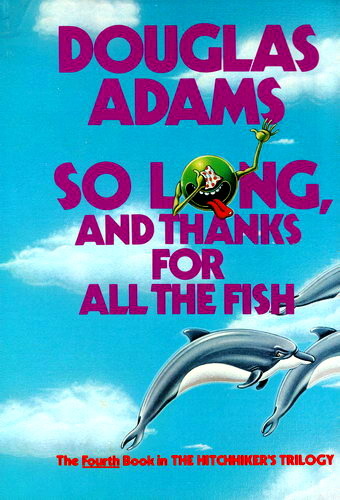
"Back on Earth with nothing more to show for his long, strange trip through time and space than a ratty towel and a plastic shopping bag, Arthur Dent is ready to believe that the past eight years were all just a figment of his stressed-out imagination. But a gift-wrapped fishbowl with a cryptic inscription, the mysterious disappearance of Earth's dolphins, and the discovery of his battered copy of The Hitchhiker's Guide to the Galaxy all conspire to give Arthur the sneaking suspicion that something otherworldly is indeed going on....
God only knows what it all means. And fortunately, He left behind a Final Message of explanation. But since it's light-years away from Earth, on a star surrounded by souvenir booths, finding out what it is will mean hitching a ride to the far reaches of space aboard a UFO with a giant robot. But what else is new?"
So this took a bit of a more relaxed track with its plot than the others; it was set just on Earth, no alien wars or anything. And I have to say it was one of my favorites. It was just simple Douglas Adams at his best. The dialogue was sharp, the observations were relevant, and the end was absolutely priceless. I think I went through this one quicker than the others, too. There were still some plot twists, slightly less out-of-the-blue than Life, the Universe, and Everything, but still enough to keep things interesting. Not much really to say other than that, so I'll leave you to decide. Five stars, by the way. There's a copy at Sitka High.
"The unhappy inhabitants of planet Krikkit are sick of looking at the night sky above their heads--so they plan to destroy it. The universe, that is. Now only five individuals stand between the killer robots of Krikkit and their goal of total annihilation.
They are Arthur Dent, a mild-mannered space and time traveler who tries to learn how to fly by throwing himself at the ground and missing; Ford Prefect, his best friend, who decides to go insane to see if he likes it; Slartibartfast, the indomitable vice president of the Campaign for Real Time, who travels in a ship powered by irrational behavior; Zaphod Beeblebrox, the two-headed, three-armed ex-president of the galaxy; and Trillian, the sexy space cadet who is torn between a persistent Thunder God and a very depressed Beeblebrox.
How will it all end? Will it end? Only this stalwart crew knows as they try to avert universal Armageddon and save life as we know it--and don't know it!"
So, you may or may not know about my absolute fondness for Douglas Adams books. On the trip I was determined to finish the Hitchhiker series, which I did, so I figured I'd give a little feedback on the two ones I read. I'd seriously missed reading stuff like this, so it made me so happy to get back into them. They're written by a man who's undeniably ridiculously smart, as well as somewhat sassy and slightly insane (which, in my opinion, is the best kind of person). Everything from the Thor cameo, to the random immortal alien bent on systematically insulting every member of the universe, was weird in the awesomest possible way. Things made simultaneously no sense and perfect sense, in the way that happens when Douglas Adams spends the entire duration of writing a science fiction book with his tongue in his cheek. I really loved it; the parallels were intelligent and funny, the characters were strange, and the plot was twisty and had some completely unexpected developments that I didn't see coming. Five stars. I would barely stop short of force to get you to start reading this series; this book's at Kettleson and Sitka High, and the first book is at Kettleson, Mt. Edgecumbe, Blatchley, and Sitka High.